Why the Cheapest Flight Can Cost More: A Real Trip Cost Guide
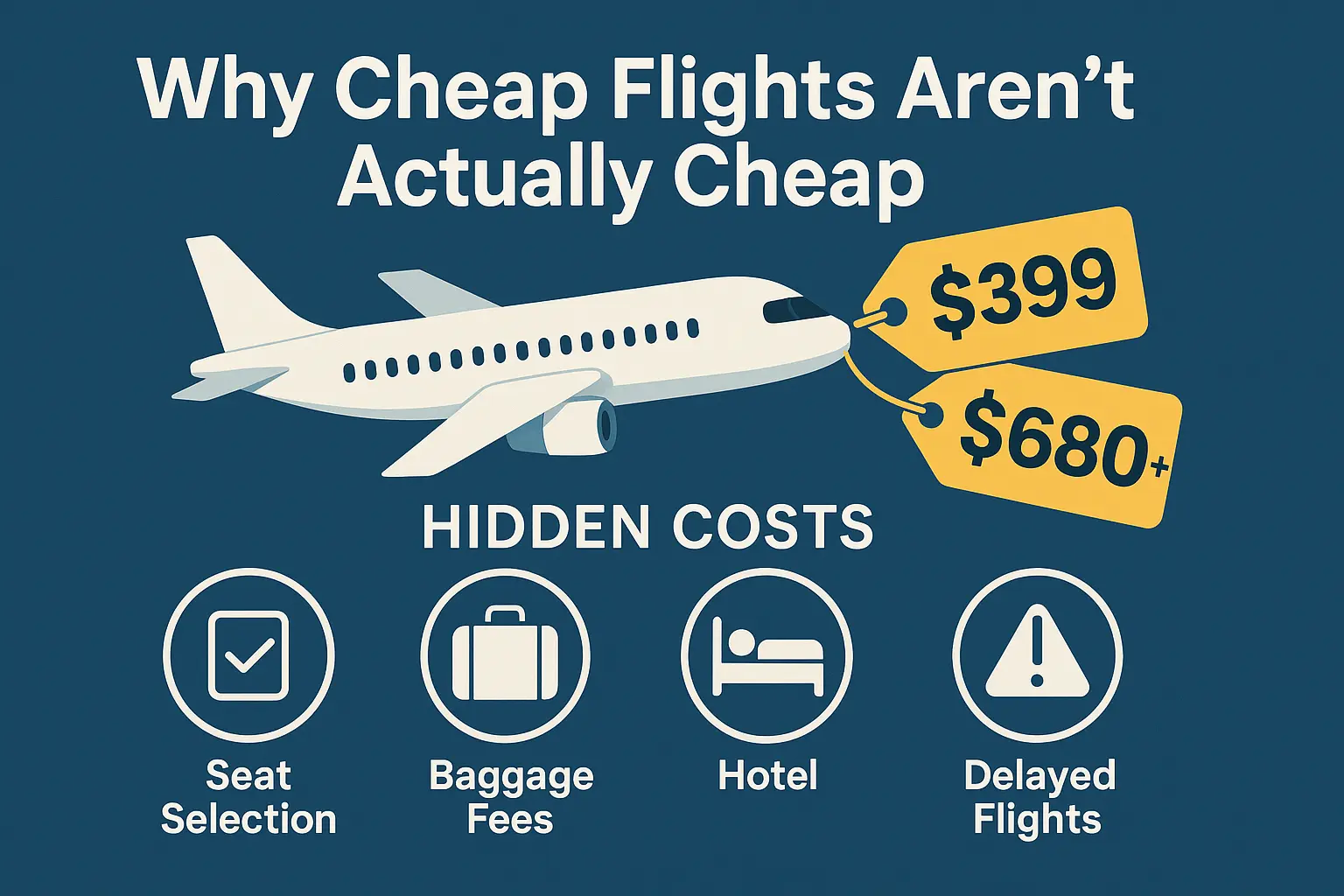
A low airfare can be a real bargain. It can also be the first number in a much more expensive journey. The difference depends on what the traveler needs after selecting the flight: luggage, seats, airport transportation, a hotel, a safer connection, or a fare that can be changed.
The problem is not that every inexpensive airline ticket is misleading. The problem is that search results often place different products beside one another. A personal-item-only fare with a self-transfer can appear next to a nonstop ticket that includes a carry-on. Comparing only the first prices treats those products as equal when they are not.
This guide provides a practical way to compare the complete trip. It separates costs that can be calculated from less predictable factors such as delay risk and personal fatigue, and it explains when a cheap fare is genuinely good value.
Start With a Transparent Real-Cost Formula
Use a calculation that can be checked:
Real Trip Cost = Final Airline Checkout Total + Airport Costs + Predictable Journey Expenses
The final airline checkout total should include the services you will actually purchase. Airport costs include parking, tolls, rail, taxi, rideshare, or a positioning trip. Predictable journey expenses include an airport hotel, meals during a planned overnight layover, or a second transfer required by the itinerary.
Keep travel time and disruption exposure beside the dollar total rather than hiding them inside an invented score. A five-hour difference matters, but its value depends on the person and trip.
What Belongs in the Comparison?
| Cost category | What to include | Common mistake |
|---|---|---|
| Airline checkout total | Fare, bags, seats, fare bundle, and required services | Comparing a bare fare with a more complete ticket |
| Airport access | Rail, fuel, tolls, parking, taxi, rideshare, or positioning airfare | Assuming the distant airport costs nothing to reach |
| Connection expenses | Hotel, meals, transfers, baggage recheck, or overnight transportation | Ignoring a long or overnight layover |
| Fare flexibility | The upgrade needed for useful change or cancellation conditions | Assuming every economy fare has the same rules |
| Travel time | Door-to-door hours, stops, overnight travel, and arrival time | Counting only the scheduled flight duration |
| Disruption exposure | Separate tickets, route frequency, connection length, and recovery options | Assigning the same risk to every itinerary |
Completed Example: The Lower Fare That Finishes Higher
The example below is hypothetical. It demonstrates the calculation and does not represent a current airline quote.
| Comparison item | Low-fare itinerary | Standard-fare itinerary |
|---|---|---|
| Round-trip base fare | $399 | $528 |
| Carry-on bag | $92 | Included |
| Checked bag | $108 | $80 |
| Required seat selection | $48 | Included |
| Overnight layover hotel and transfer | $154 | $0 |
| Airport transportation | $38 | $38 |
| Comparable total | $839 | $646 |
| Stops and scheduled journey time | 2 stops • 22 hr 10 min | 1 stop • 13 hr 40 min |
| Ticket structure | Self-transfer between separate bookings | One protected reservation |
The low-fare itinerary begins $129 below the other ticket but finishes $193 higher after the traveler's actual needs are added. It also requires a longer journey and a self-transfer.
This does not prove that every $399 fare is a bad deal. A traveler with only a personal item, free lodging, and a comfortable overnight plan could reach a different result. The point is to finish the calculation before calling the ticket cheap.
1. Baggage Can Reverse the Result
Baggage is one of the easiest costs to calculate and one of the easiest to overlook. A traveler may need only the included personal item, a full-size carry-on, one checked bag, or several bags for a family trip.
Google Flights provides a bags filter that can update displayed prices to include selected carry-on or checked bag fees. Google also advises travelers to verify size, weight, and fee rules with the airline because baggage information can vary.
Check:
- The dimensions of the included personal item.
- Whether an overhead-bin carry-on is included.
- The first and second checked-bag fees in both directions.
- Online versus airport or gate pricing.
- Weight and oversize limits.
- Status, credit-card, military, or fare-bundle benefits.
- Whether different airlines operate the itinerary.
Build the same luggage into every option. A traveler with no bag should not purchase an unnecessary bundle, and a traveler who needs two checked bags should not compare bare fares.
2. Seat Selection Is Personal—but Sometimes Necessary
Seat selection is optional for some travelers and important for others. A solo passenger may accept any assigned seat. A family, caregiver, traveler with a medical need, or passenger on a long overnight flight may decide that choosing seats is part of the real trip.
Compare the cost of the seats you will actually purchase. Do not automatically add premium seats to one fare and compare them with standard seats on another.
Families should also review the airline's current seating policy and keep everyone on the same reservation. The complete family total matters more than the per-person search result.
3. The Airport Can Cost More Than the Fare Difference
A cheaper ticket from a distant airport can add parking, tolls, rail, a hotel, or a long rideshare. The return journey matters too. A late arrival after public transportation stops operating can create a cost that did not exist on the outbound trip.
Compare:
- Round-trip airport transportation.
- Parking for the full trip.
- Tolls and fuel.
- Early-morning or late-night taxi costs.
- A hotel before an early departure.
- The value of a free ride only when it is truly available.
A $70 airfare saving can disappear quickly when the alternate airport adds $110 in transportation.
4. Long Layovers Create Predictable Expenses
A long connection is not automatically bad. It can be useful when the traveler wants a stopover, needs a safer connection, or prefers a lower fare. The mistake is treating the layover as cost-free.
Include:
- Meals and drinks.
- An airport hotel.
- Ground transportation to the hotel.
- Visa or entry requirements when leaving the airport.
- Lounge access purchased only because of the layover.
- An extra calendar day used by the journey.
A short connection also deserves attention. It may be legal and still leave little room for security, terminal movement, immigration, or a delayed first flight.
5. Self-Transfers Are Not Normal Connections
A self-transfer may combine flights that are not protected as one journey. The traveler may need to collect baggage, enter the country, move between terminals or airports, check in again, and pass through security.
When the first flight is late, the second airline may not be responsible for the missed flight. The lower fare should therefore be compared with:
- A large connection buffer.
- A possible airport hotel.
- Baggage recheck fees.
- Ground transportation between airports.
- The financial consequence of buying a replacement ticket.
Google Flights identifies some self-transfer and airport-change itineraries in its search information. Travelers should still inspect every segment and booking condition before paying.
6. Time Has Value, but It Should Not Be Faked
Travel time matters. A cheaper itinerary can consume an extra vacation day or cause the traveler to arrive too late for the first planned activity. However, assigning one universal hourly dollar amount creates false precision.
Record:
- Total door-to-door time.
- Number of stops.
- Overnight travel.
- Arrival time.
- Time needed to recover before work or an event.
Then decide what the difference means for that trip. An extra six hours may be acceptable on a long family visit and unacceptable on a three-day vacation.
7. Fare Rules Can Turn Savings Into a Loss
A restrictive fare can be excellent value when the travel plans are firm. It can be expensive when the traveler later needs to change or cancel.
Review:
- Whether voluntary changes are allowed.
- Whether a fare difference applies.
- Whether cancellation produces a refund, credit, or nothing.
- How long a credit remains valid.
- Whether the booking source controls the change.
- Whether a fare upgrade provides rules the traveler actually needs.
Do not pay for flexibility that is unnecessary, but do not compare a nonchangeable fare with a flexible fare as if they are identical.
8. Reliability Is Context, Not a Universal Penalty
The Bureau of Transportation Statistics publishes official U.S. airline service-quality data, including scheduled and actual departure and arrival information. DOT also maintains a customer-service dashboard showing airline commitments for controllable delays and cancellations.
Use those resources as context. Historical performance cannot predict one future flight, and the cost of a disruption varies by trip.
Examine:
- How many flights operate that day.
- Whether the itinerary uses the last flight of the evening.
- Whether a connection is protected.
- Weather exposure.
- Availability of partner-airline rebooking.
- Whether a delay threatens a cruise, wedding, business meeting, or international connection.
9. Booking Source Affects Who Manages the Ticket
A flight-search site may send the traveler to an airline or an online travel agency. Compare the exact itinerary and fare rules before choosing the booking source.
Review:
- Who is issuing the ticket.
- Who handles voluntary changes.
- Whether every segment is on one ticket.
- Customer-support access.
- Whether the final price matches the search result.
- Payment protections and refund responsibility.
A small third-party saving may be worthwhile for one traveler and not for another. The support arrangement is part of the product.
U.S. Refund Rights and Services Not Provided
For flights to, from, or within the United States, DOT explains when a traveler is entitled to a refund after an airline cancellation or significant change when the traveler does not accept the alternative.
DOT also states that fees for ancillary services can be refundable when the paid service is not provided. Current guidance covers services such as baggage, advance seat selection, Wi-Fi, entertainment, meals, and upgrades. Checked-bag fee refunds can also apply when a bag is significantly delayed and the traveler files the required mishandled-baggage report.
These rights do not make every trip disruption cost-free. A refund may not replace a missed event, hotel, cruise, or separately booked connection.
When the Low Fare Is Genuinely the Best Deal
A cheap flight can be the correct choice when:
- The traveler uses only the included personal item.
- The airport is easy to reach.
- The itinerary is nonstop or has a reasonable protected connection.
- The departure and arrival times work.
- The fare rules match the traveler's certainty.
- No unnecessary seats or bundles are purchased.
- The final checkout total remains lower.
Smart comparison is not about avoiding budget fares. It is about understanding them.
A 10-Minute Flight Comparison Process
- Define the trip. List travelers, bags, seat needs, airports, and acceptable stops.
- Find two or three realistic itineraries. Do not compare dozens of unusable results.
- Add the airline services. Build the same bags and seats into each option.
- Add airport costs. Include parking, rail, tolls, taxi, or a hotel.
- Add predictable connection expenses. Include overnight layovers and transfers.
- Record time and stops. Keep them beside the dollar total.
- Review fare rules and ticket structure. Identify self-transfers and separate tickets.
- Choose the best complete trip. The lowest final total may or may not win.
Use Price Tracking Instead of Repeating the Search
When a traveler is not ready to buy, Google Flights can track specific flights, routes, and dates. It can also track flexible “Any dates” searches and provide updates when prices change significantly.
Track a small number of meaningful options:
- The preferred route and dates.
- A flexible-date version.
- One realistic alternate airport.
- A nonstop option and a one-stop option.
Too many alerts recreate the same noise the traveler was trying to avoid.
How FlyToDash Helps
FlyToDash focuses on the difference between a low airfare and a useful trip. The Flight Cost Calculator can be used to add bags, seats, parking, rail, hotels, transfers, and other predictable costs.
FlyToDash AI can help travelers compare the practical differences between itineraries, including stops, schedules, baggage, and airport choices. The final fare and rules should always be verified before payment.
The goal is not to convince travelers to buy the more expensive ticket. It is to help them understand what each ticket includes before deciding.
Frequently Asked Questions
Common questions about low fares, hidden costs, self-transfers, and consumer rights.
No. A low fare can be an excellent deal when the schedule works and the traveler does not need costly extras. Add the bags, seats, transportation, and flexibility you will actually use before deciding.
Include the final airline checkout total, baggage, seats, airport transportation, parking, hotels, predictable connection expenses, and any fare upgrade needed for flexibility. Compare travel time and disruption exposure separately.
They can be worthwhile when the savings are substantial and the traveler leaves a large buffer. Separate tickets may require baggage collection and recheck, and the second airline may not protect the traveler if the first flight is delayed.
Use the baggage filter in a flight-search tool when available, then verify the exact size, weight, and fee rules with the airline. Build the same baggage needs into every comparison.
You can record the hours saved and decide what they are worth for that trip, but one universal hourly value is misleading. A lost hour matters differently on a weekend visit, a business trip, or a connection to a cruise.
For flights to, from, or within the United States, travelers can be entitled to a refund when the airline cancels or significantly changes the flight and the traveler does not accept the alternative. Review current Department of Transportation guidance for the exact situation.
Methodology and Sources
This guide was reviewed on July 28, 2026. It uses official U.S. consumer-protection, airline-performance, and flight-search documentation. The worked example is hypothetical and is clearly labeled so it cannot be mistaken for a current fare quote.
- Google Flights – Filter Flight Prices by Bag Fees
- Google Flights – Compare Fares, Self-Transfers, and Booking Options
- Google Flights – Track Flights and Prices
- U.S. Department of Transportation – Airline Refund Rights
- U.S. Department of Transportation – Lost, Delayed, or Damaged Baggage
- U.S. Department of Transportation – Airline Cancellation and Delay Dashboard
- Bureau of Transportation Statistics – Airline On-Time Performance
Important: Fares, airline fees, baggage rules, schedules, and consumer guidance can change. Confirm the current itinerary, final checkout price, operating airline, booking source, and fare rules before purchasing.