U.S. Airlines by Real Trip Cost: A Practical 2026 Comparison
A $79 flight can be a genuine bargain. It can also become a $190 trip after a carry-on, checked bag, seat, airport transportation, and fare upgrade are added. The only way to know is to compare the trip you will actually take—not the smallest number displayed at the beginning of the search.
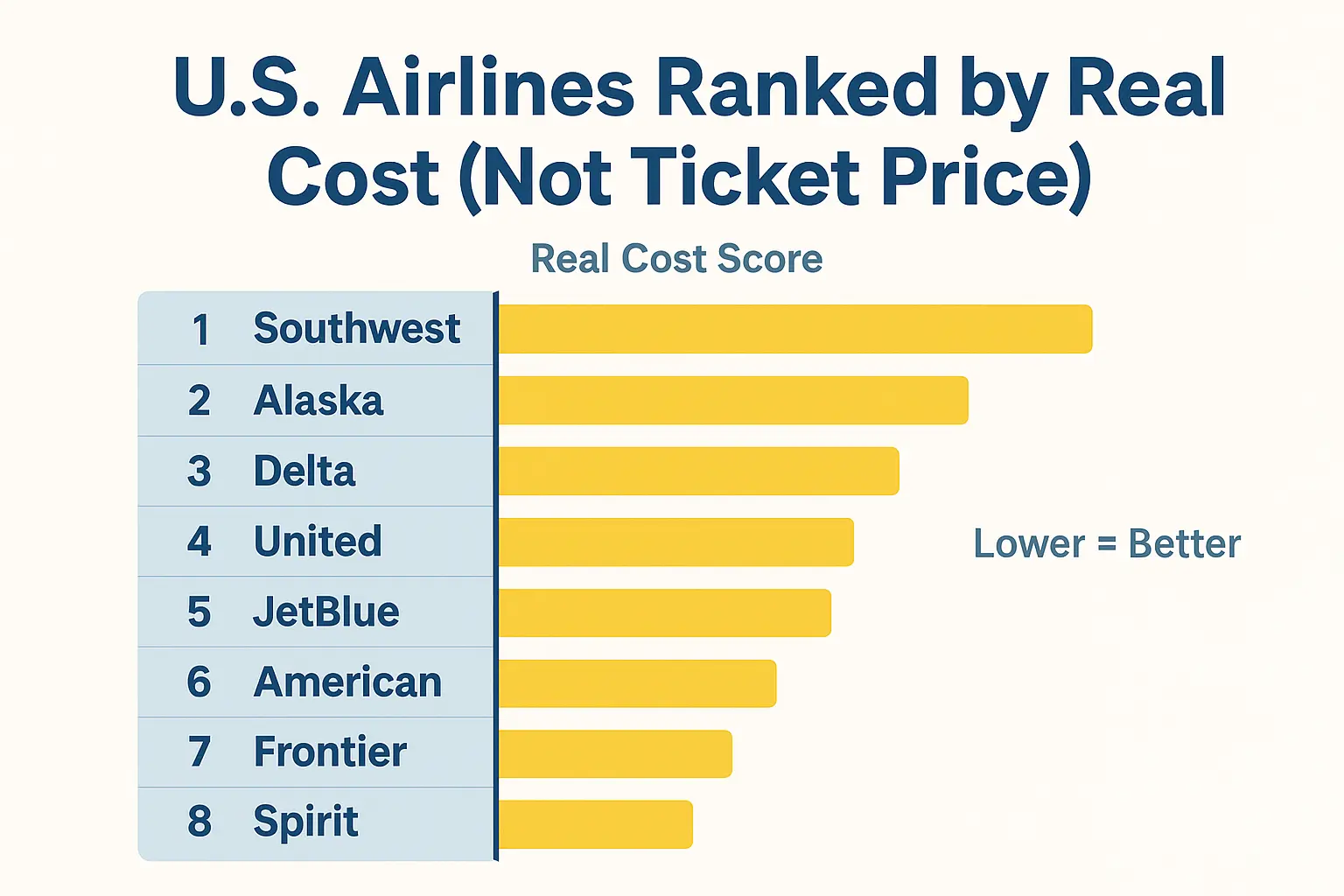
This is why a permanent ranking of U.S. airlines from “cheapest” to “most expensive” does not work very well. The lowest-cost airline for a solo traveler with a backpack may be completely different from the best-value airline for a family of four checking bags. Route, airport, schedule, loyalty benefits, and fare type can change the result again.
This guide uses a scenario-based approach. It explains which cost factors matter, shows how current bag policies can affect the total, and helps travelers compare airlines without pretending that one carrier wins every trip.
Why the Original Ticket Price Is Incomplete
A fare shown in search results may include taxes, but it may not include every optional service a traveler needs. Depending on the airline and fare, the final total can change when bags, seats, priority services, or flexibility are selected.
The itinerary also creates costs that do not appear in the airline's checkout total. A distant airport can add parking or ground transportation. A long overnight connection can require a hotel. A late arrival can create a taxi expense when public transportation has stopped running.
A useful comparison includes:
- Base airfare: the fare for the exact flights and cabin.
- Carry-on and checked bags: based on the traveler, route, fare, and purchase timing.
- Seat needs: especially for families or travelers who require a particular location.
- Fare flexibility: the rules for changing or canceling the ticket.
- Airport cost: parking, tolls, train fare, rideshare, or a hotel.
- Schedule cost: an extra stop, overnight connection, or lost vacation time.
- Recovery options: how easily the airline can reroute the traveler if the trip is disrupted.
A Better Real-Cost Formula
FlyToDash recommends a transparent calculation instead of a hidden score:
Real Trip Cost = Final Airline Checkout Total + Airport/Positioning Costs + Predictable Trip Expenses
Keep delay and cancellation history separate. Reliability matters, but assigning one fixed “delay penalty” to every traveler creates false precision. A two-hour delay can be inconvenient on a normal visit and extremely expensive before a cruise, wedding, international connection, or business meeting.
Use operational data as context:
- Does the route operate once a day or many times?
- Is there another flight if the original one is canceled?
- Is the itinerary nonstop or connecting?
- Is the connection protected on one ticket?
- Would a delay create a hotel, missed event, or missed international flight?
Current Domestic Bag-Fee Snapshot
Airline fees change, and benefits can depend on fare, route, status, credit card, military eligibility, or purchase date. The following examples show why an old airline ranking can become inaccurate quickly. Always verify the airline's current fee page for the exact trip.
| Airline | Current comparison point | Why the final total varies |
|---|---|---|
| Southwest | For U.S. mainland travel booked or changed on or after April 9, 2026, Basic, Choice, and Choice Preferred list $45 for the first checked bag and $55 for the second. | Choice Extra, status, and eligible credit-card benefits can change the allowance. |
| Delta | Delta lists $45 for the first standard domestic checked bag and $55 for the second for covered Delta Main and Delta Comfort travelers without listed exemptions. | Status, eligible cards, military benefits, cabin, route, and ticket date can change the fee. |
| American | For many domestic tickets issued under its 2026 policy, American lists $45 online or $50 at the airport for the first bag and $55 online or $60 at the airport for the second. | Basic Economy can cost more, while status, eligible cards, and premium cabins may include bags. |
| Alaska | Alaska announced $45 for the first checked bag and $55 for the second for applicable North American tickets issued on or after April 10, 2026. | Status, eligible cards, cabin, and Alaska or Hawaii programs can change the allowance. |
| JetBlue | JetBlue lists $45 for the first off-peak checked bag and $60 for the second on covered Blue-family fares. | Peak dates, fare type, route, Mint, and other benefits can change the total. |
| United | United directs travelers to a route- and traveler-specific checked-bag calculator. | Route, cabin, status, membership, card benefits, and prepayment can affect the charge. |
| Spirit | Spirit's Value option includes a personal item; carry-on and checked bags can be purchased separately. Premium Economy includes a carry-on, and Spirit First includes a carry-on and first checked bag. | Travel option, route, timing, bags, seat, and optional services determine the total. |
| Frontier | Frontier sells optional bags and seats and offers bundles that can include services. | Fees vary by service, route, purchase timing, bundle, and travel date. |
These examples are not a complete fee chart. They demonstrate why the traveler should compare the final checkout total for the actual reservation.
There Is No One Airline Ranking—There Are Traveler Scenarios
Scenario 1: Personal-Item-Only Traveler
A traveler carrying only the included personal item can sometimes get excellent value from Spirit, Frontier, or another low-fare option. The base product may be enough, so there is no reason to add a bag or seat simply because other travelers need them.
Compare:
- The personal-item dimensions.
- The airport and departure time.
- Whether the flight is nonstop.
- The cost of correcting an oversized item at the airport or gate.
- The rules if plans change.
For this traveler, a low-cost carrier can remain genuinely cheap. A blanket statement that budget airlines are “always more expensive” would be wrong.
Scenario 2: Traveler With a Standard Carry-On
The comparison changes when a full-size carry-on is needed. Many major-airline economy products include a standard carry-on and a personal item, while some lower-fare products charge for the carry-on or include it only in a bundle.
Add the carry-on before comparing totals. Also check whether the fare limits boarding or overhead-bin access. A low fare can still win, but only after the required bag is included.
Scenario 3: Traveler Checking One Bag
One checked bag can narrow or erase the difference between two airlines. The correct comparison uses the fee for the exact ticket date, route, fare, and traveler—not a fee remembered from last year.
Check for:
- Online-prepayment discounts.
- Basic Economy differences.
- Credit-card or loyalty benefits.
- Weight limits and overweight charges.
- Whether the bag benefit applies to companions.
Scenario 4: Traveler Checking Two Bags
Two bags can make fare bundles, premium fares, status, and eligible credit-card benefits much more important. Do not assume Southwest is automatically the winner based on its former universal two-free-bag policy. Its current U.S. mainland policy varies by fare and traveler benefit.
Compare the full round-trip amount. A $55 second-bag fee each way adds $110 to one traveler's round trip. For a family, the effect can multiply quickly.
Scenario 5: Family Traveling Together
Families should compare more than bags. Seat assignment, nonstop value, flight time, airport access, and the availability of replacement flights can matter more than a small airfare difference.
The U.S. Department of Transportation maintains a current family-seating dashboard showing which airlines commit to adjacent seating for a child age 13 or under and an accompanying adult at no additional charge, subject to listed conditions. Review the dashboard and the airline's policy rather than relying on an old list.
Families should also:
- Book everyone on the same reservation.
- Review seat selections before payment.
- Compare the total for all passengers, not the per-person fare.
- Check stroller, car-seat, and baggage rules.
- Consider whether a connection is worth the savings.
Scenario 6: Traveler Who May Need to Change Plans
A restrictive fare can be inexpensive when the trip is certain. It can be costly when the traveler later needs to change or cancel it. Review whether the fare allows changes, whether only a credit is offered, whether a fare difference applies, and when the credit expires.
U.S. refund rights for airline-canceled or significantly changed flights are different from a voluntary change made by the passenger. The Department of Transportation explains when ticket and ancillary-fee refunds are due. The airline's fare rules explain what happens when the passenger decides not to travel.
Scenario 7: Time-Sensitive Traveler
A traveler going to a wedding, cruise, business event, or international connection should examine schedule resilience. A nonstop flight with several departures that day may be more valuable than a cheaper flight that operates once.
Reliability data can help, but route structure often matters just as much:
- Number of daily departures.
- Availability of partner-airline rebooking.
- Connection length.
- Seasonal weather.
- Last flight of the day versus an earlier departure.
Why a Fixed Delay Penalty Is Misleading
The original idea of adding an average dollar amount for delay risk sounds objective, but it can hide important differences. The same delay does not create the same cost for every person.
Consider two travelers:
- Traveler A is visiting family with no fixed event that evening.
- Traveler B is connecting to a cruise that leaves the same day.
A two-hour delay may be frustrating for Traveler A and financially serious for Traveler B. Instead of assigning one universal dollar penalty, mark the itinerary's disruption exposure as low, medium, or high for the actual trip.
DOT's Air Travel Consumer Reports and BTS on-time databases provide official information on delays, cancellations, mishandled baggage, oversales, and other service measures. Use current data as supporting evidence, not a guarantee of one future flight.
Worked Example: Comparing the Complete Trip Cost
The example below is hypothetical and is included to show how two fares that look very different at first can produce a different result after the services a traveler actually needs are added. These are not live airline prices.
| Comparison item | Low-fare option | Standard-fare option |
|---|---|---|
| Round-trip base fare | $168 | $298 |
| Carry-on bag | $118 | Included |
| Checked bag | $0 | $0 |
| Required seat selection | $54 | Included |
| Airport transportation | $36 | $18 |
| Predictable connection expense | $22 | $0 |
| Comparable trip total | $398 | $316 |
| Stops and total travel time | 1 stop • 7 hr 40 min | Nonstop • 5 hr 15 min |
| Change or cancellation conditions | More restrictive | More flexible |
| Recovery options if disrupted | Fewer same-day alternatives | Several same-day alternatives |
In this example, the low-fare option begins $130 cheaper but finishes $82 more expensive after the traveler adds the carry-on, seat, transportation, and predictable connection cost. The standard-fare option also saves more than two hours and provides more recovery choices.
Travelers who want to compare their own numbers can use the FlyToDash Flight Cost Calculator rather than trying to type into a static article table.
Example: Why the Lowest Base Fare May or May Not Win
Imagine a solo round trip with the following options:
- Airline A: $88 base fare, plus $70 for the required carry-on and $32 for a selected seat.
- Airline B: $165 base fare with the carry-on included and no paid seat needed.
Airline A totals $190, while Airline B totals $165. Airline B is cheaper for this traveler.
Now remove the carry-on and seat because the traveler can use only the included personal item. Airline A returns to $88 and becomes the clear low-cost choice. The airline did not change; the traveler's needs changed.
How Loyalty Status and Credit Cards Change the Result
Airline status and eligible credit cards can include checked bags, preferred seats, priority services, or other benefits. These benefits can make a higher base fare less expensive for one traveler than for another.
Verify:
- Whether the ticket must be purchased with the card.
- Whether companions on the same reservation receive the benefit.
- Whether the flight must be operated by the airline.
- Whether Basic Economy is eligible.
- Whether the annual fee changes the value for occasional travelers.
Do not subtract the full annual credit-card fee from one trip or pretend it is free. Evaluate the card across the year and the benefits actually used.
Airport Choice Is Part of Airline Cost
Airlines often dominate different airports. A lower fare from a distant airport can require more fuel, tolls, parking, or an overnight hotel. A nearby airport may cost more in airfare and less overall.
Compare:
- Door-to-door travel time.
- Parking or public transportation.
- Departure and return time.
- Whether the return arrives after transit stops operating.
- Weather and traffic exposure.
- Number of daily flights to the destination.
Consumer Protections Belong in the Comparison
The Department of Transportation states that passengers can be entitled to automatic refunds when an airline cancels or significantly changes a flight and the passenger does not accept the alternative offered. DOT also explains when fees for ancillary services or significantly delayed or lost checked baggage may be refundable.
The DOT customer-service dashboard shows voluntary airline commitments for controllable cancellations and delays, including rebooking and certain meals, hotels, or ground transportation. Commitments differ by airline and can change, so check the live dashboard before travel.
These protections do not make every disruption cost-free. A refund may not replace a missed event, hotel, cruise, or separately booked connection. That is why itinerary design still matters.
How FlyToDash Uses “Real Cost” Responsibly
FlyToDash uses real cost as a comparison method, not as a permanent airline score. The process begins with the traveler's actual needs and uses current airline information.
- Compare the exact flights and travelers.
- Add the bags and seats that will actually be used.
- Include fare or bundle upgrades only when needed.
- Add airport and predictable itinerary expenses.
- Review travel time, stops, and recovery options separately.
- Confirm the final total and fare rules before payment.
This approach may identify a low-cost carrier as the best choice for one trip and a network carrier as the best choice for another. That is the point: the comparison should follow the trip, not a brand reputation.
Frequently Asked Questions
Common questions about airline fees, bags, families, and complete trip cost.
There is no universal winner. An ultra-low-cost carrier may be cheapest for a traveler carrying only a personal item, while another airline may cost less for a family, a traveler checking bags, or someone who needs flexibility.
Not for every traveler or fare. For U.S. mainland travel booked or changed on or after April 9, 2026, Southwest lists checked-bag charges for Basic, Choice, and Choice Preferred fares. Choice Extra and certain status or credit-card benefits can include bags.
No. They can remain the lowest-cost choice for travelers who accept the schedule and travel with only the included item. Their value changes when carry-ons, checked bags, seat selection, changes, or other services are added.
Families should compare the complete reservation, including bags, seat needs, nonstop value, schedule, airport access, and the airline's current family-seating policy. DOT maintains a live family-seating commitments dashboard.
Usually not as a universal fixed penalty. Delay and cancellation data are better used as context or a tie-breaker because the financial effect depends on the trip, schedule, connections, hotels, events, and available recovery flights.
Build the same trip on each airline using the same travelers, bags, seats, fare flexibility, and airports. Compare the final checkout total and review current fee pages because airline policies can change.
Methodology and Sources
This article was reviewed on July 28, 2026. It does not publish a permanent airline leaderboard because fares, fees, schedules, benefits, and traveler needs change. The comparison uses current official airline policy pages and U.S. government consumer resources.
- Southwest Airlines – Optional Travel Charges
- Delta Air Lines – Baggage Policy and Fees
- American Airlines – Bag and Optional Fees
- Alaska Airlines – 2026 Bag-Fee Update
- JetBlue – Optional Services and Fees
- United Airlines – Checked-Bag Fee Calculator
- Spirit Airlines – Bag Information
- Frontier Airlines – Optional Services
- U.S. Department of Transportation – Airline Family Seating Dashboard
- U.S. Department of Transportation – Airline Customer Service Dashboard
- U.S. Department of Transportation – Airline Refund Rights
- U.S. Department of Transportation – Air Travel Consumer Reports
- Bureau of Transportation Statistics – Airline On-Time Statistics
Important: Airline fees and policies can change. The ticket purchase date, route, fare, cabin, status, credit-card benefits, military eligibility, and purchase channel may affect the total. Confirm the current price and rules directly with the airline before purchasing.