
UK to Pakistan Flight Prices: When Fares Usually Rise and Fall
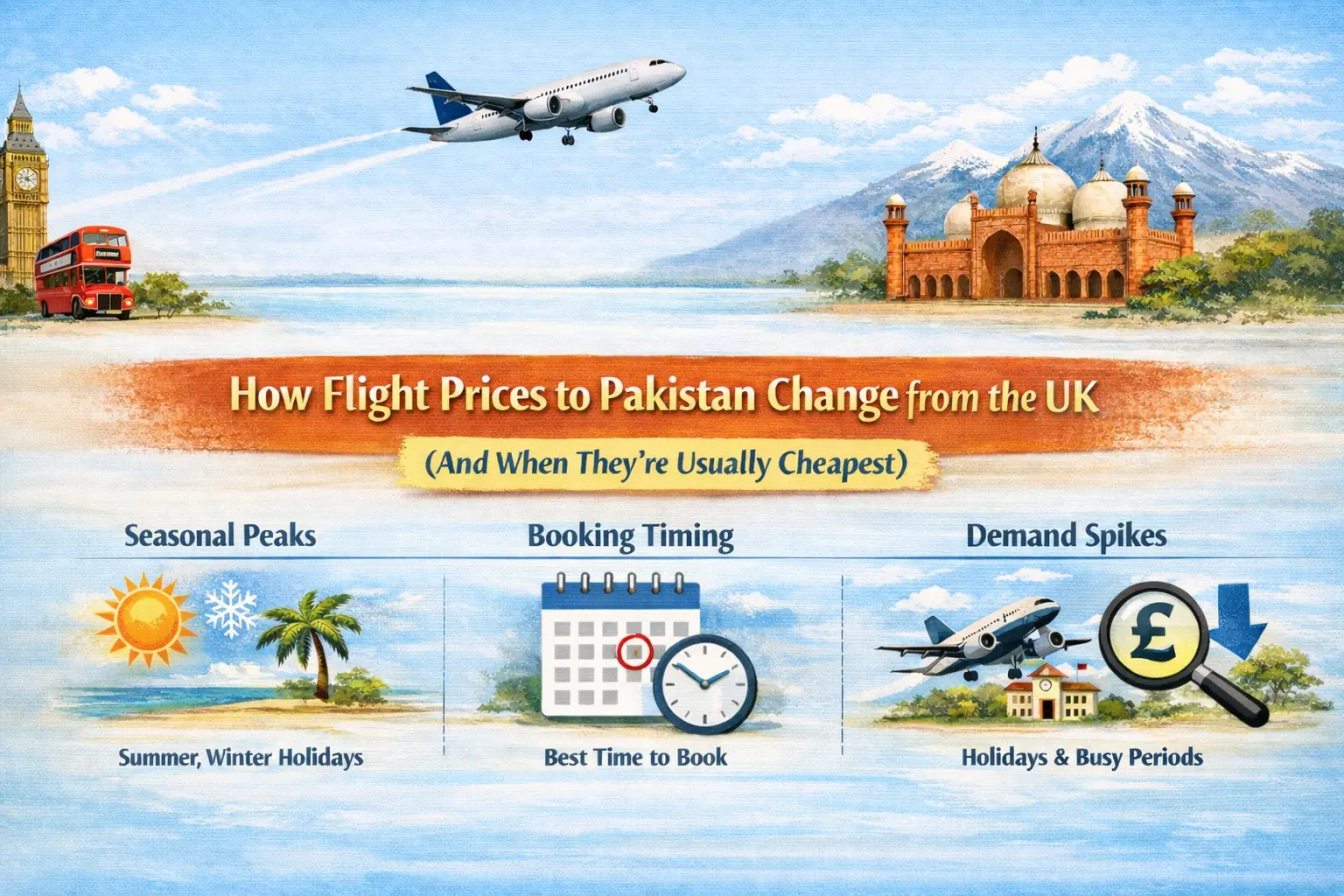
A UK-to-Pakistan fare can look reasonable one evening and noticeably higher a few days later. That can feel random, especially when the route, dates, and cabin appear unchanged. In most cases, however, the movement is connected to seat availability, demand, travel timing, or a change on one part of the itinerary.
The important point is that there is no permanent “correct” price for London to Islamabad, Lahore, Karachi, Sialkot, or another Pakistani city. The same route can be inexpensive during one travel period and costly during another. Two travellers leaving a week apart may face completely different demand.
This guide explains the patterns that matter most: school holidays, summer demand, year-end travel, booking timing, direct-versus-one-stop choices, departure-airport comparisons, baggage, and the hidden cost of reaching a supposedly cheaper airport.
Why UK-to-Pakistan Fares Move So Much
An aircraft does not have one price for every economy seat. Airlines commonly divide seats into different fare levels. Several passengers may sit in the same cabin while paying different amounts because they booked from different availability levels or selected fares with different rules.
When the lower-priced seats sell, the next available level can be much higher. That is why a fare sometimes appears to “jump” rather than increase gradually. The change may happen across the full journey or on only one segment of a connecting itinerary.
The main forces are:
- Seat availability: fewer low-priced seats remain as a flight fills.
- Travel demand: more people want the same dates during school holidays and family-travel periods.
- Route capacity: fewer practical flights can place more pressure on the available seats.
- Connection availability: one full connecting segment can raise the price of the entire trip.
- Fare conditions: baggage, changes, refunds, and seat selection can make two similar results different products.
Typical Demand Patterns Through the Year
| Travel period | What often happens | What to do |
|---|---|---|
| Winter after the New Year rush | Demand may ease once major holiday travel has passed | Compare flexible dates and weather-related connection risk |
| Spring school breaks | Family demand can rise around local school calendars | Check dates just before and after the break |
| Late spring outside major holidays | Some routes may show a calmer demand period | Compare direct and one-stop options before summer pressure builds |
| Summer school holidays | Higher family-travel demand can reduce lower-fare availability | Monitor earlier and avoid waiting for one perfect price |
| Early autumn after schools return | Demand may soften for travellers with flexible schedules | Test several departure and return combinations |
| Late December and early January | Holiday demand can push up fares and reduce convenient options | Compare nearby dates and book when an acceptable itinerary appears |
These are broad tendencies, not fixed rules. Religious holidays, wedding travel, family events, airline schedule changes, and local school calendars can shift demand. A month that was good value one year may behave differently the next.
School Holidays Matter More Than the Day You Click “Search”
Travellers sometimes focus on whether Tuesday or Wednesday is the best day to buy. For UK-to-Pakistan travel, the dates being flown usually matter more than the day the search is performed.
When many families want to leave shortly after schools close and return just before classes resume, the most convenient flights fill first. The remaining choices may involve higher fares, longer connections, or less useful departure times.
A better strategy is to compare:
- The first few days of the school break.
- A departure one or two days before the busiest family-travel period.
- A return a day earlier or later.
- Midweek travel versus the most convenient weekend dates.
Moving both directions is not always necessary. Sometimes changing only the outbound or only the return can move the itinerary into a lower fare level.
Is There a Best Month to Fly?
A single “cheapest month” answer is attractive, but it can be misleading. The better-value month depends on the departure airport, Pakistani destination, trip length, school calendar, airline schedule, and how flexible the traveller can be.
Instead of treating one month as guaranteed, compare three layers:
- Broad season: peak family travel versus a quieter period.
- Week of travel: school breaks, holidays, and popular weekend patterns.
- Exact flights: direct or one stop, departure time, baggage, and connection length.
A flexible-date calendar can reveal that the lowest part of a month is concentrated in only a few days. The monthly label alone does not tell the full story.
How Far in Advance Should You Start Looking?
There is no booking window that works for every UK-to-Pakistan trip. Travellers going during summer or a major holiday usually have less room to wait than people travelling during a quieter period.
Start early enough to learn the normal range for your route. You do not need to purchase the first result. Monitor the same trip several times while keeping the details consistent:
- Same departure and destination airports.
- Same dates or the same flexible range.
- Same number of passengers.
- Same cabin.
- Same baggage needs.
- Same direct or one-stop preference.
Once a suitable itinerary reaches a reasonable price, waiting should be a conscious choice. During a popular period, lower-priced seats can disappear while the traveller waits for a small additional saving.
Why a Fare Can Rise Overnight
A sudden increase can come from several different changes:
- The lower fare level sold out. The next available seats are priced higher.
- One connecting segment filled. The international flight may still have space, but the feeder flight does not.
- A promotional fare ended. A temporary offer or lower fare rule is no longer available.
- The itinerary changed. The result now uses a different flight, airport, cabin, or booking provider.
- Demand increased. More travellers began purchasing the same dates.
When a fare jumps, do not immediately assume every flight for that period has become expensive. Try:
- Moving the outbound by one day.
- Moving the return by one day.
- Comparing direct and one-stop itineraries.
- Checking another realistic UK departure airport.
- Testing a nearby Pakistani arrival airport only when ground travel is sensible.
Direct Versus One Stop: What Are You Paying For?
A direct itinerary removes the connection, shortens the journey, and reduces the chance of missing an onward flight. That convenience can command a higher price, especially when direct capacity is limited for the dates travellers want most.
A one-stop itinerary can create more choices because it combines the UK departure with a larger international connecting network. The tradeoff is additional travel time and another point where delays or baggage problems can occur.
Direct Travel May Be Worth More When:
- You are travelling with young children.
- An older passenger needs a simpler journey.
- The trip is short and time matters.
- You are carrying several checked bags.
- The one-stop fare has an overnight or very long connection.
- The connection arrives at an inconvenient time.
One Stop May Be Better When:
- The saving is substantial after all fees are added.
- The connection is on one ticket and has a reasonable length.
- The final destination has limited direct options.
- The traveller is comfortable with a longer journey.
- The one-stop schedule is more convenient than the available direct flight.
Compare the complete journey in both directions. A good outbound connection can be paired with a poor return.
London Is Not the Only UK Departure Point Worth Checking
London provides a broad range of international choices, but it is not automatically the best starting point for every traveller. Manchester, Birmingham, Glasgow, and other airports may be worth comparing when they are closer to home or produce a cleaner itinerary.
The comparison should include more than the international ticket:
- Rail tickets or fuel.
- Airport parking.
- A hotel before an early departure.
- Extra baggage charges on a separate domestic segment.
- The return journey after a long overnight flight.
- The risk of using separate tickets.
A Simple Total-Cost Example
Suppose a London departure is £180 less than a flight from the airport nearest home. Reaching London adds £70 in rail travel, £45 in local transport, and £120 for a hotel because the departure is early. The London option now costs £55 more before meals or extra time are considered.
The opposite can also happen. A family may save far more by travelling to a larger airport, especially when the ground journey is simple and no hotel is needed. The decision belongs to the complete trip, not the headline fare.
What Changes Between Islamabad, Lahore, Karachi, and Sialkot?
Pakistan should not be treated as one airfare market. Islamabad, Lahore, Karachi, and Sialkot have different schedules, demand patterns, and connecting possibilities. A good London-to-Islamabad fare does not guarantee the same value to Lahore or Karachi.
Search the city you actually need first. Then compare another Pakistani airport only when the ground transfer is practical for the traveller and family receiving them.
A lower fare to a different city may not be a saving after adding:
- Domestic travel inside Pakistan.
- Fuel, tolls, or hired transport.
- An overnight stay.
- Additional travel time after a long flight.
- The burden on relatives collecting the passenger.
Baggage Can Change Which Fare Is Actually Cheapest
UK-to-Pakistan travellers often need checked baggage, so a headline fare without the required allowance may not be the true price. Compare the exact baggage rules for every airline and fare type.
Check:
- Number of checked bags.
- Weight allowed per bag.
- Carry-on allowance.
- Fees for an extra bag.
- Rules when different airlines operate the segments.
- Whether bags are checked through to the final destination.
A slightly higher fare can be the better value when it includes the baggage the traveller already knows they will need.
Why Separate Tickets Require Extra Care
A traveller may see a cheap flight to London followed by a separate international ticket to Pakistan. This can reduce the displayed fare, but the two bookings are usually not protected as one journey.
If the first train or flight is delayed, the international airline may not be responsible for the missed departure. The traveller may also need to collect bags and check in again.
Include a large buffer. For an expensive international ticket, reaching the departure city the previous day can be safer than relying on a tight same-day connection. The hotel and transport costs belong in the comparison.
Does the Day You Search Matter?
There is no reliable rule that one weekday always produces the cheapest UK-to-Pakistan fare. Prices can move whenever inventory, demand, or fare rules change.
The more useful habit is to search consistently:
- Compare the same route and passenger details.
- Use flexible-date views.
- Track a small number of meaningful alternatives.
- Check the final fare directly before booking.
- Record whether baggage and seat costs are included.
Repeated searching is not proof that the website caused the increase. The cheaper availability may simply have changed while the traveller was comparing options.
A Practical UK-to-Pakistan Search Process
- Search the closest realistic UK airport. This gives you the baseline price and journey.
- Compare London when it is practical. Add the full cost of reaching and leaving the airport.
- Test one other regional airport. Manchester or Birmingham may be useful depending on where you live.
- Move each date by one or two days. Check whether the fare difference comes from the outbound or return.
- Compare direct and one-stop options. Note the total time and connection quality.
- Apply baggage needs. Do not compare a fare without bags with one that includes them.
- Check the Pakistani city separately. Islamabad, Lahore, Karachi, and Sialkot may price differently.
- Review the total before paying. Confirm airport codes, operating airlines, bags, seats, and ticket rules.
How to Know When a Fare Is Reasonable
The lowest possible price is unknowable in advance. A more useful goal is to understand the current range and decide what combination of price and itinerary quality is acceptable.
A reasonable fare should be judged together with:
- Travel period and demand.
- Direct or one stop.
- Total journey time.
- Baggage allowance.
- Departure and arrival times.
- Change and cancellation conditions.
- Cost of reaching the UK departure airport.
If a suitable itinerary compares well with the normal range you have been monitoring, continuing to search indefinitely may create stress without improving the trip.
How FlyToDash Helps With the Comparison
FlyToDash helps travellers move from general fare patterns to actual route comparisons. The useful approach is to begin with the UK departure airport closest to home, then compare London or another realistic alternative.
Travellers can also compare the Pakistani destination directly. This matters because a fare pattern for Islamabad may not match Lahore, Karachi, or Sialkot.
The aim is not to chase the smallest number at any cost. It is to find an itinerary that is fairly priced, manageable, and clear about baggage, connections, and total travel time.
Frequently Asked Questions
Common questions about UK-to-Pakistan fares, travel timing, and airport choices.
There is no single cheapest month every year. Better-value periods are more likely outside school holidays, major family-travel peaks, and year-end demand. Flexible dates and live comparisons are more reliable than one fixed monthly rule.
A sudden increase often means the lower-priced seats have sold, demand has strengthened, or one part of the itinerary has become less available. The higher fare may be caused by only one flight segment.
Not always, but direct travel can be valuable for families, older passengers, short trips, and travellers carrying several bags. Compare the price difference with the time, connection risk, and overnight costs saved.
Yes, when those airports are realistically accessible. Add rail, fuel, parking, hotel, baggage, and return-travel costs before deciding that another departure airport is cheaper.
Prices can change while you search because flight inventory updates frequently. Repeated searching alone is not a dependable explanation for every increase. Compare the same dates, flights, fare type, bags, and booking source.
Start monitoring early for school holidays and other high-demand periods, but do not rely on one universal booking window. Track the normal range for your exact route and book when a suitable itinerary reaches a price you consider reasonable.
Methodology and Notes
This guide was reviewed on July 28, 2026. It is designed to explain the main forces that affect UK-to-Pakistan fares rather than predict a guaranteed cheapest month, booking day, or airline.
- Focused on route-specific factors such as school-holiday demand, seat availability, baggage, and connections.
- Compared the practical role of London and other UK departure airports without assuming one is always cheapest.
- Included complete-trip costs such as rail, fuel, parking, hotels, and separate-ticket risk.
- Avoided presenting a temporary fare sample as a permanent route average.
- Used live-route pages as the appropriate place to check current prices for exact dates.
Important: Flight prices and schedules can change at any time. Confirm airport codes, baggage allowance, connection requirements, operating airlines, and the complete final price before purchasing.